
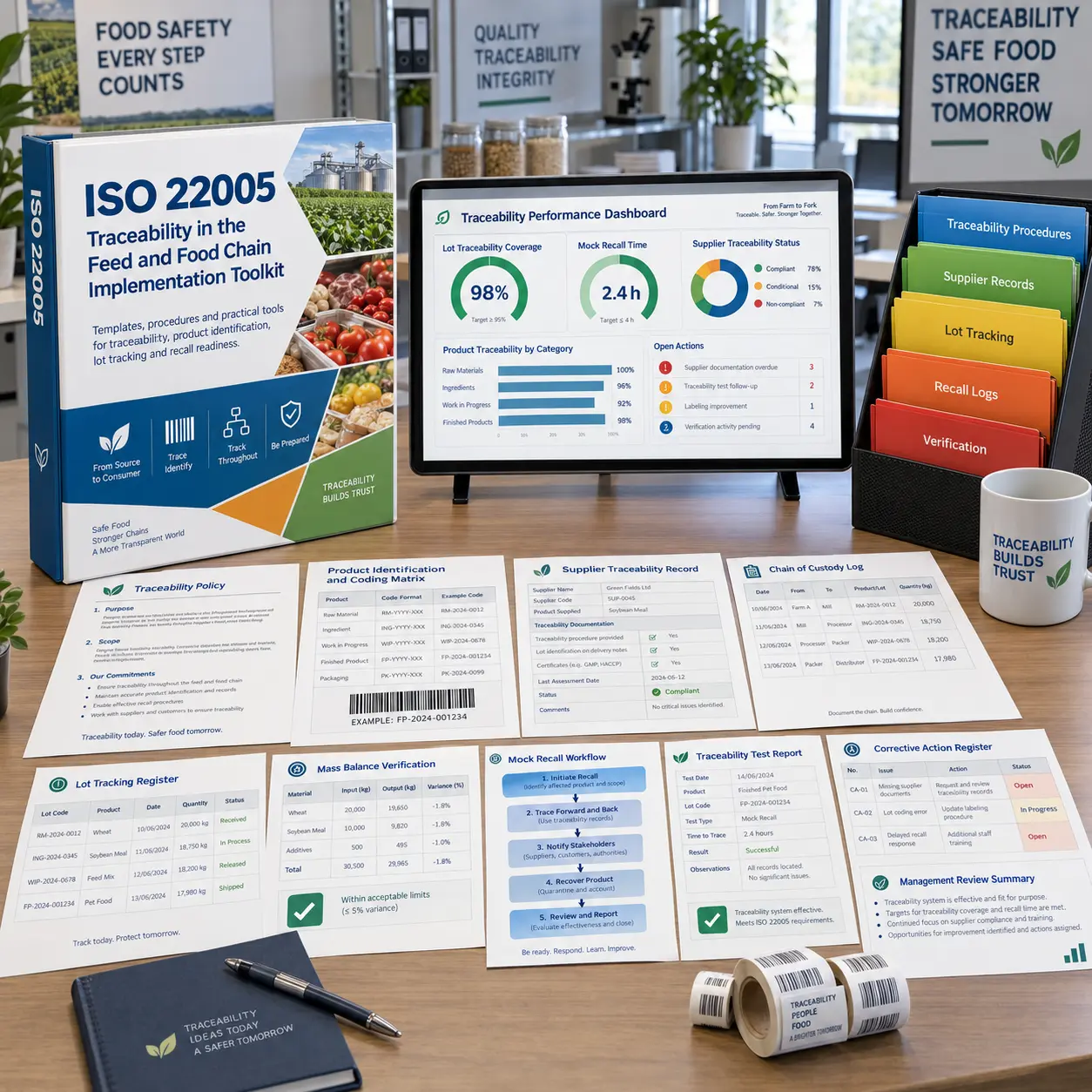
The ISO 22005:2007 Traceability Implementation Toolkit provides a structured set of editable templates and practical working tools to help organizations design, implement, operate, verify, and improve traceability systems across the feed and food chain.
Aligned with the principles and basic requirements of ISO 22005:2007, this toolkit converts traceability objectives into practical procedures, registers, worksheets, checklists, test records, dashboards, and implementation controls. It supports product identification, lot and batch management, supplier-to-customer linkage, processing traceability, record integrity, withdrawal and recall investigation, mock recall testing, and ongoing traceability performance improvement.
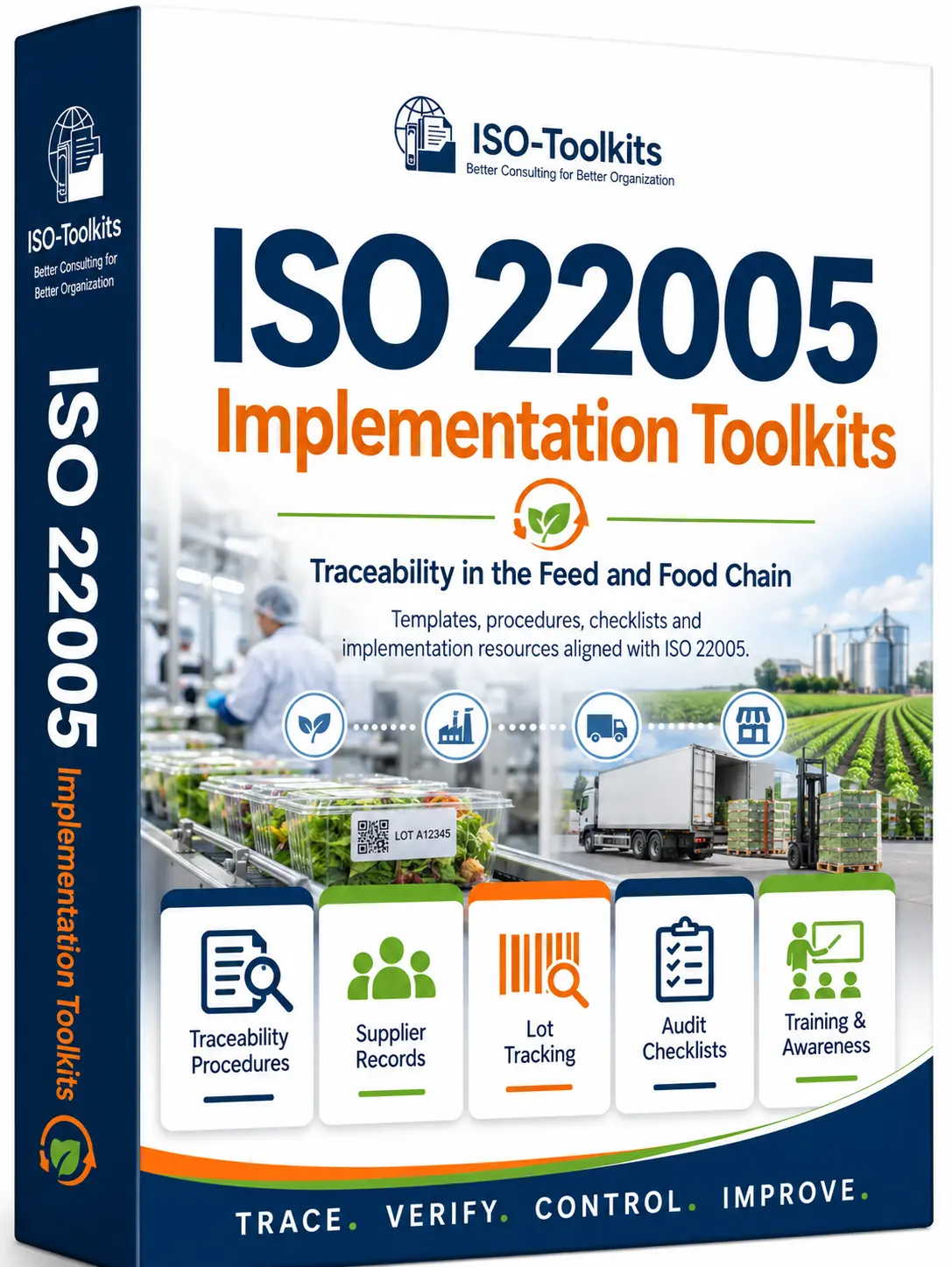
Designing a reliable traceability system across suppliers, receiving, processing, storage, distribution, and customer channels can require substantial coordination. Organizations need consistent product identification, lot and batch linkage, accurate traceability records, clear ownership, data integrity controls, and the ability to reconstruct product movement quickly during investigations or recalls.
The ISO 22005:2007 Feed and Food Chain Traceability Implementation Toolkit provides a structured collection of easy to use templates and implementation documents in Word, Excel, and PowerPoint formats. It helps your organization establish traceability objectives, map the feed and food chain, control product identification, link supplier and customer information, manage internal transformations, test recall traceability, monitor system performance, and hand over a practical operating framework to process owners.

Below is the structured list of documents included in the package. Use the quick navigation or expand each part to review the files before downloading the index file.
 Part 1. Program Initiation & Traceability Objectives
 ISO 22005 Implementation Charter.docx
 Traceability System Applicability Assessment.xlsx Traceability Objectives Definition Worksheet.xlsx Current Traceability Practice Assessment.xlsx Existing Traceability Documentation Review.xlsx Traceability Gap & Improvement Action Plan.xlsx Implementation Roadmap.xlsx Traceability Roles & RACI Matrix.xlsx
 Project Kick-off Deck.pptx
Part 2. Scope, Requirements & Feed/Food Chain Mapping
Traceability Scope & Boundary Worksheet.xlsx Product Family & Process Scope Register.xlsx Feed and Food Chain Mapping Workbook.xlsx Process Flow & Material Flow Map.xlsx Supplier Customer & External Party Register.xlsx Legal Regulatory Customer & Contractual Traceability Requirements Register.xlsx Internal & External Traceability Interface Matrix.xlsx Traceability Critical Control Points Register.xlsx Traceability Scope Approval Record.docx
Part 3. Traceability System Design & Governance
Traceability System Design Specification.docx Traceability System Procedure.docx Traceability Governance Framework.docx Traceability Roles & Responsibilities Matrix.xlsx Traceability Data Flow & Responsibility Matrix.xlsx Traceability Information Requirements Matrix.xlsx Traceability System Interface Register.xlsx Traceability Decision & Escalation Matrix.xlsx Traceability System Design Review Checklist.xlsx Traceability System Approval Record.docx
Part 4. Product Identification, Coding & Lot/Batch Management
Product Identification & Coding Standard.docx Product Master Traceability Register.xlsx Raw Material Identification Register.xlsx Lot Batch & Serial Number Coding Matrix.xlsx Lot Batch Creation Record.xlsx Re-labelling & Re-coding Control Form.docx Traceability Label Verification Checklist.xlsx Packaging Identification & Traceability Register.xlsx Lot Split Merge & Rework Traceability Record.xlsx Identification Exception Register.xlsx
Part 5. Supplier, Receiving & Inbound Traceability
Supplier Traceability Requirements.docx Supplier Traceability Questionnaire.docx Supplier Traceability Capability Assessment.xlsx Approved Supplier Traceability Register.xlsx Incoming Material Traceability Record.xlsx Supplier Lot-to-Internal Lot Linkage Register.xlsx Receiving & Traceability Verification Checklist.xlsx Certificate Specification & Traceability Evidence Register.xlsx Inbound Traceability Discrepancy Report.docx Supplier Traceability Corrective Action Tracker.xlsx
Part 6. Internal Processing, Transformation & Work-in-Process Traceability
Internal Process Traceability Procedure.docx Production Batch / Lot Traceability Record.xlsx Input-to-Output Transformation Record.xlsx Work-in-Process Traceability Register.xlsx Ingredient & Component Usage Register.xlsx Process Step Traceability Log.xlsx Rework Reprocessing & Carryover Traceability Record.xlsx Co-product & By-product Traceability Record.xlsx Production Quantity & Mass Balance Reconciliation.xlsx Internal Traceability Exception Register.xlsx
Part 7. Finished Product, Storage & Outbound Distribution Traceability
Finished Product Traceability Register.xlsx Finished Product Lot Release Record.xlsx Warehouse Location & Lot Traceability Register.xlsx Stock Movement Traceability Log.xlsx Order-to-Lot Allocation Register.xlsx Dispatch & Shipment Traceability Record.xlsx Customer Lot Distribution Register.xlsx Transport & Logistics Traceability Register.xlsx Returns & Reverse Traceability Register.xlsx Outbound Traceability Verification Checklist.xlsx
Part 8. Traceability Records, Data Integrity & Information Control
Traceability Records Control Procedure.docx Traceability Records Master Index.xlsx Traceability Data Field Dictionary.xlsx Traceability Record Ownership Matrix.xlsx Traceability Data Entry & Validation Checklist.xlsx Traceability Data Integrity Review.xlsx Traceability Record Retention Schedule.xlsx Electronic Traceability System Access Matrix.xlsx Traceability Data Backup & Recovery Requirements.xlsx Traceability Data Exception & Correction Log.xlsx
Part 9. Product Withdrawal, Recall & Incident Traceability
Traceability Incident Response Procedure.docx Product Traceability Investigation Form.docx Affected Lot Identification Workbook.xlsx One-Step-Back Traceability Worksheet.xlsx One-Step-Forward Traceability Worksheet.xlsx Full Chain Traceability Investigation Workbook.xlsx Affected Customer & Distribution Register.xlsx Affected Supplier & Input Register.xlsx Product Withdrawal / Recall Traceability Checklist.xlsx Traceability Incident Decision & Action Log.xlsx Traceability Evidence Pack Index.xlsx
Part 10. Traceability Verification, Testing & Performance Evaluation
Traceability Verification Procedure.docx Annual Traceability Test Program.xlsx Traceability Test / Mock Recall Plan.docx Traceability Test Scenario Template.docx Backward Traceability Test Record.xlsx Forward Traceability Test Record.xlsx Mass Balance Verification Workbook.xlsx Traceability Response Time Tracker.xlsx Traceability Completeness & Accuracy Assessment.xlsx Traceability Test Findings Register.xlsx Traceability Corrective Action Tracker.xlsx Traceability Test Report.docx Traceability Performance Dashboard.xlsx
Part 11. Review, Improvement & Operational Handover
Traceability System Review Checklist.xlsx Traceability KPI Register.xlsx Traceability Issue & Improvement Register.xlsx Traceability Root Cause Analysis Template.docx Traceability Improvement Action Plan.xlsx Traceability System Change Impact Assessment.xlsx Annual Traceability Review Plan.xlsx Traceability Maturity Reassessment.xlsx Traceability Lessons Learned Register.xlsx Operational Handover Checklist.xlsx Consultant Handover Checklist.xlsx Final Implementation Report.docx Final Executive Handover Deck.pptxReview the complete file index, preview free sample templates, or check the purchase and payment guide.
| Date File Updated | 25/03/2025 |
| File Format | pdf, xls, doc, docx, xlsx, pptx |
| No. of files | 115 File; 11 Folders |
| File download size | 7.16 MB (.rar) |
| Language |
 English
|
| Purchase code | ISO22005-Toolkits |
The lot and batch registers helped our team move from several separate spreadsheets to a much clearer traceability structure. The templates were easy to adapt to our product coding rules.
The chain mapping and supplier linkage worksheets are very practical. We used them to document information flow from incoming ingredients through finished product dispatch.
The mock recall documents gave us a structured way to test backward and forward traceability. They also helped us record response time and corrective actions after the exercise.
I liked the traceability data dictionary and record ownership matrix. They helped clarify exactly which data fields each department was responsible for maintaining.
The supplier traceability questionnaire and inbound verification checklist were useful for strengthening traceability requirements with external suppliers.
Our production team used the transformation and work-in-process records to improve batch linkage during mixing, rework, and repacking activities.
The toolkit made it easier to prepare a full traceability investigation. The one-step-back and one-step-forward worksheets are simple but very effective.
We found the records control and data integrity tools helpful because our traceability evidence comes from both manual logs and an electronic system.
The mass balance workbook and traceability verification records provided a useful framework for testing whether our operational data was complete and consistent.
The package gave our quality team a practical starting point for a new site. We could customize the registers without changing our existing ERP system.
The withdrawal and recall section is well structured. It helped us connect affected lots, suppliers, customers, evidence, decisions, and follow-up actions in one process.
A useful implementation toolkit for traceability work. The final review, maturity reassessment, and handover documents helped us transition the project into normal operations.